
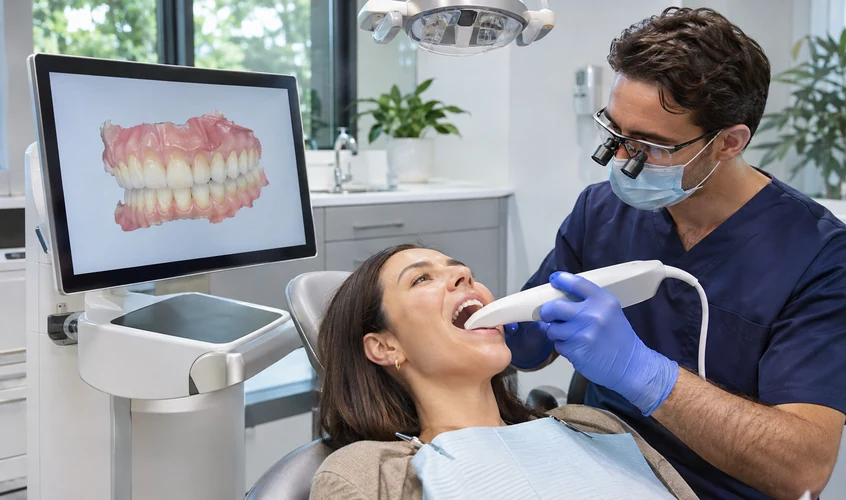
If it's been a few years since your last dental visit, you might be surprised by how different the experience feels. Gooey impression trays are being replaced by quick digital scans. X-rays appear on a screen in seconds, sometimes with software highlighting areas to look at more closely. And this year, dentistry reached a new milestone with the first MRI system designed specifically for dental care.
Here's a look at how AI and digital technology are changing the dental visit in 2026, and what it means for you as a patient.
Key Takeaways
- AI software can help dentists review X-rays by flagging possible cavities, bone loss and other concerns.
- AI supports your dentist's judgment. It doesn't replace the diagnosis.
- Intraoral scanners create 3D images of your teeth without messy impression material.
- Digital X-rays use less radiation than older film X-rays.
- The first dental-dedicated MRI received U.S. FDA clearance in 2026, offering radiation-free imaging of soft tissue.
AI-Assisted X-Ray Reading
Artificial intelligence has made its way into many dental offices through software that analyzes X-rays. These programs are trained on huge numbers of images and can highlight areas that may show early decay, bone loss around teeth, old fillings that are breaking down or signs of infection at a tooth's root. For patients, this can mean:- Earlier detection. Small issues may be flagged before they cause symptoms.
- Clearer explanations. Colour-coded images make it easier to see what your dentist is talking about.
- More consistency. AI acts like a second set of eyes during a busy day.
Intraoral Scanners: Goodbye, Goopy Impressions
If you've ever gagged on impression putty, you'll appreciate this one. Intraoral scanners are small wands that take thousands of pictures as they move around your mouth, building an accurate 3D model of your teeth in a few minutes. Digital scans are used for crowns, bridges, implants, night guards and clear aligners. Benefits include:- A more comfortable experience, especially if you have a strong gag reflex
- Accurate fit, with fewer remakes
- Faster turnaround, since files can be sent to a lab instantly
- The ability to see your teeth on screen and preview treatment
Digital X-Rays and 3D Imaging
Digital X-rays have largely replaced film in many offices. They produce images instantly and use less radiation than traditional film. If you've ever been nervous about X-ray exposure, our article on whether you should say no to dental X-rays explains why they're still an important tool. For more complex cases, such as implant planning, impacted wisdom teeth or root canal problems, dentists may use cone beam CT (CBCT). It creates a 3D image of your teeth, jaw and nerves, which helps with precise treatment planning. Learn more about the pros and cons of dental implants.The First Dental MRI
One of the biggest imaging announcements of 2026 was the FDA clearance of the first dental-dedicated MRI system, developed by Dentsply Sirona and Siemens Healthineers. Unlike X-rays and CT scans, MRI uses no ionizing radiation. It's also much better at showing soft tissue. According to the companies, the system can help show inflammation, assess whether a tooth's pulp is still healthy, and visualize nerves and the jaw joint. That could be useful for root canal diagnosis, gum disease, TMJ problems and planning extractions. There are a couple of things to keep in mind. The system is intended for hospitals, large clinics and universities, so you won't find it at a typical neighbourhood practice yet. It's also not commercially available in every country. Still, it signals where dental imaging is heading.Other Tech You Might Notice
- Intraoral cameras let you see close-up photos of your own teeth.
- Digital smile design software previews cosmetic results before treatment.
- Online booking and reminders make it easier to stay on schedule.
- 3D printing is used for guards, models and surgical guides.
What This Means for You
Technology can make dental visits faster, more comfortable and easier to understand. If you feel anxious about the dentist, a quick scan instead of an impression or seeing your own X-rays explained on screen can make a real difference. Our tips on reducing anxiety at the dentist can help, too. Not every office uses the same tools, so if technology matters to you, ask when you call to book.Frequently Asked Questions
Is AI diagnosing my teeth?
No. AI software highlights possible concerns, but your dentist makes the diagnosis and treatment plan.Are digital scans covered by insurance?
Scans are usually part of the treatment they're used for, such as a crown or aligners. Coverage depends on your plan.Can I get a dental MRI in Newmarket?
Not at this time. Dental MRI is new and is currently aimed at hospitals and large institutions.The Bottom Line
From AI-assisted X-rays to digital scans and the first dental MRI, 2026 is shaping up to be a big year for dental technology. The goal is simple: catch problems earlier and make care more comfortable. Search our directory to find a Newmarket dentist and ask what technology they use.* Newmarket Dentist provides general information only. Our aim is to provide the most accurate information possible, but we do not take responsibility for any errors. In order to get the best results it is important to consult with your dentist or health care professional for further information, diagnosis or treatment.
